
Making History Stick: Engaging Young Readers Through Historical Fiction
Guest post by Kate Schoedinger, M.Ed, MFA
How do we engage young readers in historical fiction?
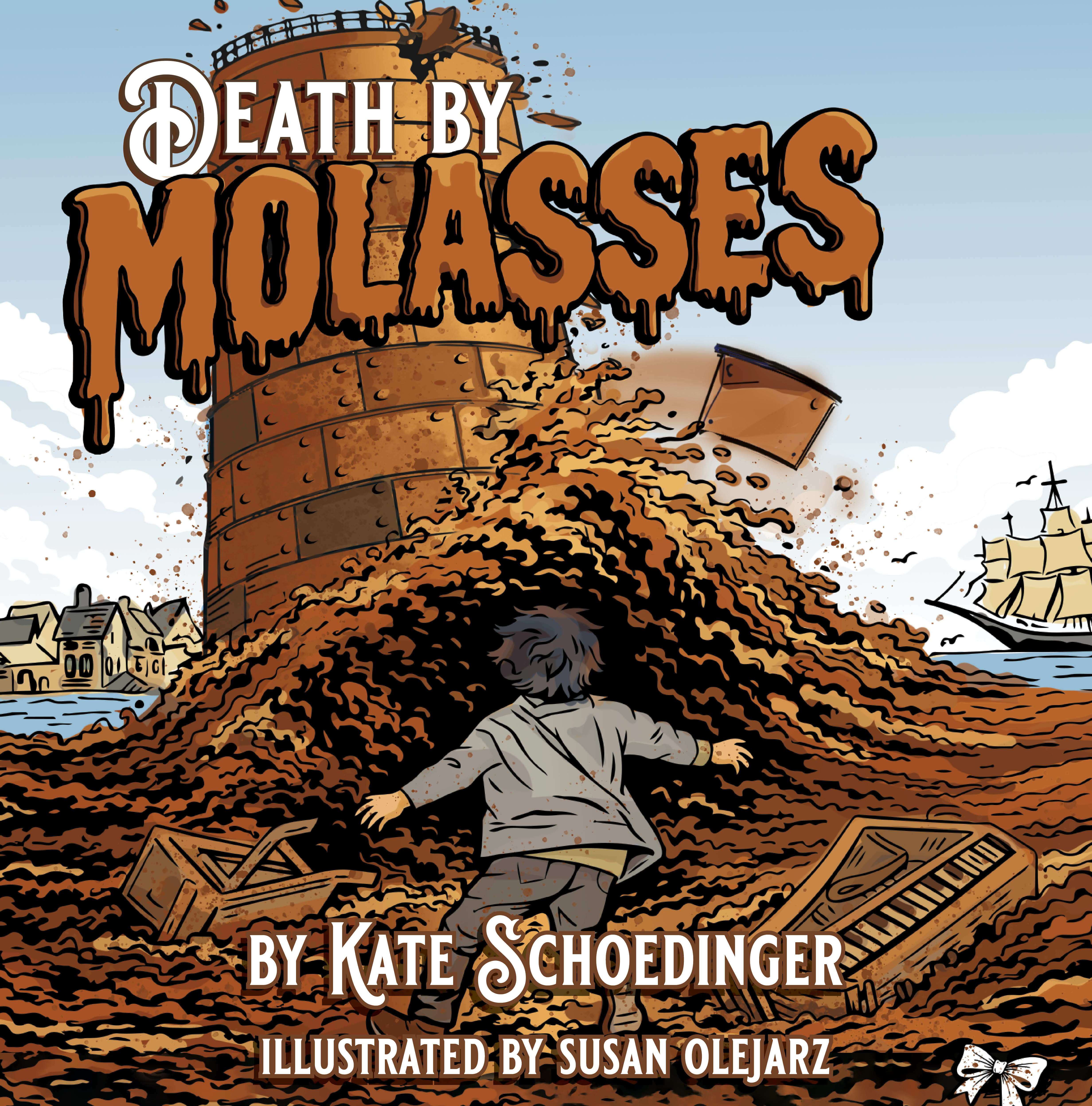
In my middle-grade novel, Death by Molasses, I use the Great Boston Molasses Flood of January 15, 1919 as the backdrop for a story about courage, responsibility, and the consequences of putting profit before safety. Four characters anchor the narrative, each offering a different entry point into this tumultuous period. Luca, a 10-year-old Italian immigrant inspired by real-life survivor Anthony DiStasio, must find the courage to speak after devastating personal loss. Charles White, the accountant overseeing the tank, dismisses workers’ warnings and compromises safety in pursuit of profit. Nevi, fourteen, must choose between continuing her education and working in the mills to support her two younger sisters after losing her mother to the Spanish flu. Mateo, a young apprentice, recognizes the tank’s inadequacies and tries to alert his superiors.
These characters give students heroes to root for, adults to question, and difficult choices to debate. Like the memorable child heroes and despicable adults in Roald Dahl’s books, these characters grip young readers—but their world is rooted in a true historical disaster.
The story also opens a window onto Boston in 1919, a time of Spanish flu, labor unrest, anarchist fears, police strikes, and the rush to distill molasses into rum before Prohibition. My research uncovered details that make history tangible: children baking potatoes in classroom coal stoves for lunch, public health posters urging people to stop spitting, and a leaking molasses tank painted brown to conceal its flaws.
Each chapter identifies the point-of-view character and begins with a pencil sketch by illustrator Susan Olejarz. These illustrations provide visual anchors for comprehension, encourage prediction, and spark curiosity about what comes next. A companion writing journal, Step Into Your Story, extends the experience with prompts inspired by the sketches, illustrations students can enlarge and color, and a cut-and-play matching game. A molasses cookie recipe adds one final taste of the era. Writing, coloring, matching, and listening to the lively audiobook give students different ways to participate and demonstrate understanding.
As a longtime reading specialist, I designed these choices to make the book accessible across ages and interests. Elementary students newly introduced to historical fiction can enjoy a read-aloud, follow the text, and explore the illustrations. Middle-grade students can read independently or together, pausing for discussion, while high school students can investigate the science, engineering failures, historical context, and legal consequences of the disaster. Classroom questions address literary elements; truth, courage, and responsibility; justice and the legal system; power, greed, and industrialization; immigration and community; science and safety; and personal reflection. Teachers can select the questions and activities that best fit their students and curriculum, using one book to encourage literacy, historical inquiry, creative expression, and critical thinking.
Ultimately, Death by Molasses invites students to connect the past with the present. What happens when profit takes precedence over people? Whose warnings are heard, and whose are ignored? How can an ordinary person challenge a powerful institution? The disaster’s legal aftermath offers an opportunity to examine accountability and the evolution of workplace safety protections, while Luca’s story encourages students to consider the courage it takes to use one’s voice. Historical fiction becomes especially powerful when readers care about the people experiencing history before stepping back to analyze its larger lessons.
My hope is that students will be captivated by the audacity of the disaster, curious about the historical facts, and inspired to ask questions that extend beyond the final page. Sometimes, the best way to make history stick is to invite young readers to step into the story themselves.

Kate Schoedinger recently retired after forty joyful years teaching in Bedford, New Hampshire where she learned daily from the curiosity, humor, and persistence of her students. Kate holds an M.Ed., from Antioch of New England, an MFA in Writing for Children and Young Adults from Vermont College of Fine Arts, and a BA from Wittenberg University. Kate lives in Weare, NH and is also a founding board member of the New Hampshire Book Festival.
Kate's Recommended Resources:
Historical Fiction Authors and Books
Candace Fleming
An exemplary model for showing students and teachers how historical research can become compelling storytelling. Fleming often teaches classes and offers educator resources, including teaching guides and classroom activities.
Recommended books:
- Amelia Lost: The Life and Disappearance of Amelia Earhart
- The Enigma Girls: How Ten Teenagers Broke Ciphers, Kept Secrets, and Helped Win WWII
Steve Sheinkin
A great resource for fast-paced narrative nonfiction that shows students how history can be as suspenseful as a novel. His website also offers teacher guides, excerpts, and other materials.
Recommended books:
- Bomb: The Race to Build and Steal the World's Most Dangerous Weapon
- The Port Chicago 50: Disaster, Mutiny and the Fight for Civil Rights
- The Bletchley Riddle (co-written with Ruta Sepetys)
Additional Recommended Titles
- A Single Shard by Linda Sue Park
- Fever 1793 by Laurie Halse Anderson
- Bud, Not Buddy by Christopher Paul Curtis
Picture Book
Route 66: Faces and Places Along America's Most Famous Road by Beth Bacon
"My author friend, Beth Bacon, has a new book out that I adore and am so impressed by."
Teaching and Research Resources
- Library of Congress: Getting Started with Primary Sources
- TeachingHistory.org: A Civil War Through a Child's Eye
- Crafting Stories from the Past: A How-to Guide for Writing Historical Fiction, edited by Mari Anne Christie