
What’s Your Literacy Lens?
This is the second post in guest contributor Emily Carley‘s five-part series “Neuroinclusive Spaces for All! When Access to Literacy Affirms Identity and Feels Like Belonging.” Read her previous post here.
Developing a sense of belonging begins with relationships. Learning to read and spell is complex, and it takes years to become proficient.
Children must engage routinely in the challenging tasks of mastering foundational phonological skills. For children struggling to learn to read, this learning can look and feel very different from their peers. A child who displays avoidant behaviors about books may be a dyslexic child with unmet learning needs.
Preparation for creating a community of belonging
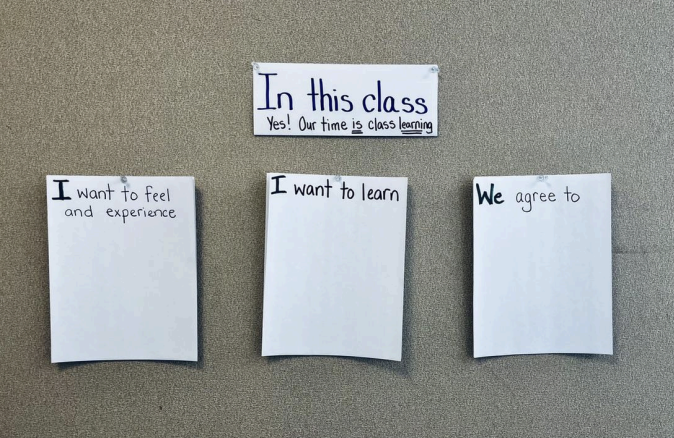
My first task is to build trust and safety. Establishing an inclusive environment for literacy learning begins with belonging. One way to start is by creating a set of agreements with group members of all ages that support social emotional success, and academic engagement.
As shown in this next image, the instructor also contributes to the process. Contributions from every member of the group help folks get to know one another in a kind, respectful manner with a clear focus.
In the image above, you can see a set of agreements for a small group that will be used to support individual reading instruction with students in the middle grades. Keeping the focus on what each person wants to feel and accomplish helps make the conversation highly specific toward achieving both the student and the instructor’s goals: proficient reading, spelling and writing skills. It is equally important to value the skill of listening and asking clarifying questions during the process of collective agreement making. Be curious about one another, and be kind!
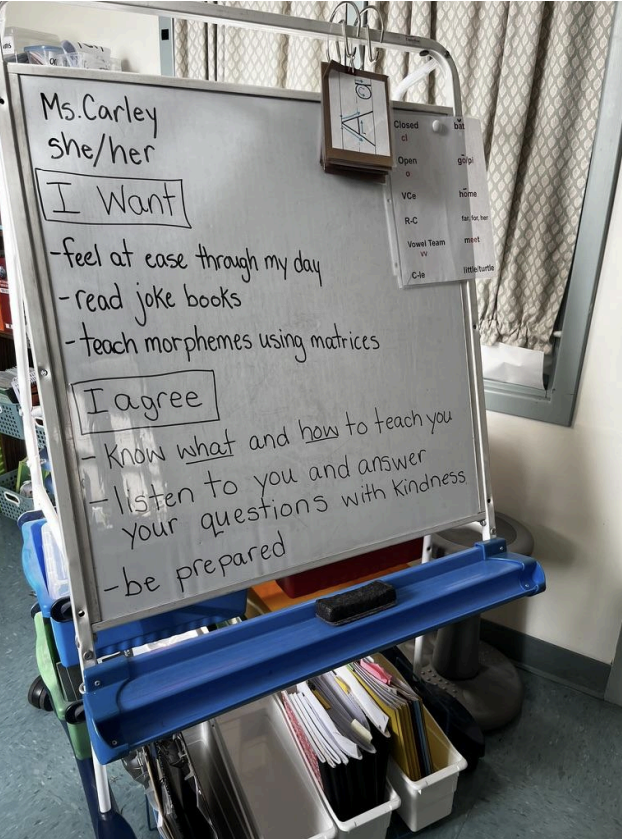
Agreements are posted and opportunities are taken to return to the statements when a social emotional challenge occurs, or an accomplishment toward a goal is achieved. For example, to ensure we each feel heard and we are efficient with our time, we will learn each other’s communication preferences and invite each other in, as well as call out talk-overs or outbursts kindly as they occur.
Understanding why these moments happen creates valuable opportunities to practice social-emotional learning, which can be woven into community development. This will be the focus of the third post in this series.

Emily Carley, M.Ed.
HQVTED & Specialized Literacy Professional Lic. PK-12
With more than 20 years experience in public education, 15 as a dedicated early elementary classroom educator in Vermont public schools, Emily is a master educator PK-12. She’s an Orton-Gillingham Classroom Educator & Associate Certified instructor skilled in Structured Linguistic Literacy.
Emily teaches graduate courses, supports fellow educators with joy, connection and persistence so all can learn to read. She is founder of The Literacy Spark, LLC and a full-time public school district literacy specialist.
Emily is a certified Educating Children Outdoors (ECO) educator and published author, trained in RULER (Brackett, PhD) social/emotional intelligence and is a neurodiversity & inclusion educator.
Emily’s instruction is scientifically-based, systematic, explicit, multisensory and emotionally sound for all ages. She is an unwavering advocate for dignity in education.
Emily enjoys seeking her own new experiences: watercolor painting, pruning untamable fruit trees and finding world’s best coffee in little-known shops when traveling.
References:
Introduction to Neurodiversity: Harvard Health Publishing, Harvard Medical School. Nov. 23, 2021. What is Neurodiversity
Definition of Neurodiversity: Dunne, Maureen. (2024). The Neurodiversity Edge : The Essential Guide to Embracing Autism, ADHD, Dyslexia, and Other Neurological Differences for Any Organization. Wiley.
Definition of Neurodiversity: National Autistic Society. Autism and Neurodiversity.
Neurodiverse / Neurotypical Communication: Why Autistic and Non-Autistic People Misunderstand Each Other – and How to Fix It: Verywell Mind, Amy Marshall, PsyD. February 10, 2025. Medically reviewed by Claire Eggleston, LMFT-Associate
Literacy Instructional Needs. Young, Nancy. 2024. A Closer Look (chapter 2). Nancy Young and Jan Hasbrouck (editors). Climbing The Ladder of Reading & Writing: Meeting the Needs of ALL Learners (book). Benchmark Education.
28% of US Adults are Not Yet Reading: U.S. Department of Education, National Center for Education Statistics. 2023. Data Point, Program for the International Assessment of Adult Competencies (PIAAC).
Dyslexic Experience: Eide, Brock and Fernette Eide. 2023. The Dyslexic Advantage: Unlocking the Hidden Potential of the Dyslexic Brain. Plume.
17.4%: Shaywitz, Bennett A., & Shaywitz, Sally E. 2020. The American Experience: Towards a 21st century Definition of Dyslexia. Oxford Review of Education.
Neuroinclusive Spaces: Gutierrez, Joelene. Personal Email Communication. July 10, 2024. Subject: use of space so all children are able to access engagement in learning.